Judicial independence and it's practial implementation in Pakistan
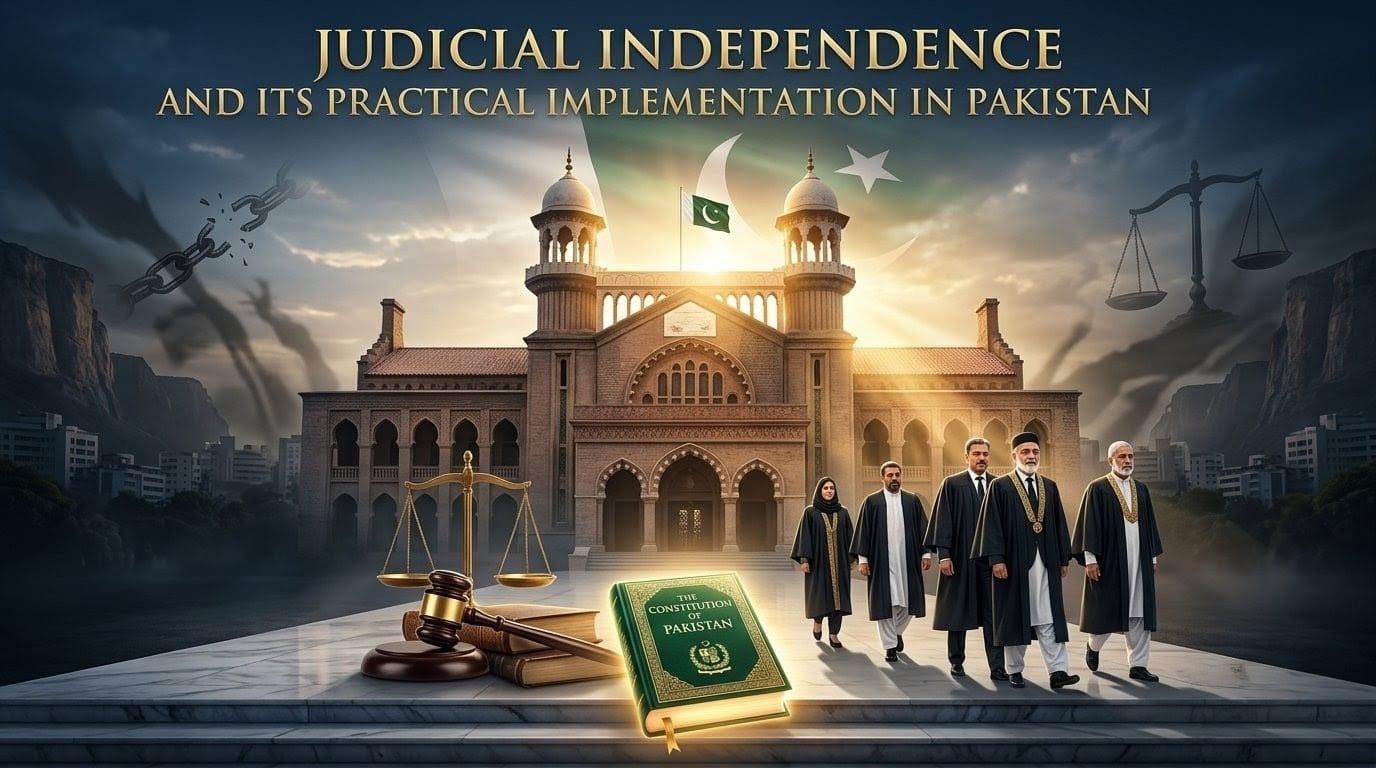
Judicial independence and it's practial implementation in Pakistan
Author: Hafeezullah Abbas
Abstract
Judicial independence has been constitutionally recognized as a foundational principle of Pakistan’s democratic order; however, its practical realization has remained deeply contested. This research examines Pakistan’s constitutional history and present to demonstrate how executive and military interventions have persistently undermined judicial autonomy. Through a historical and doctrinal analysis of constitutional developments, landmark judgments, and institutional practices, the study traces the transformation of judicial interference from occasional deviation into a systemic feature of governance. Emphasis is placed on the erosion of institutional independence of the judiciary, highlighting how executive control over appointments, functioning, and security of tenure has compromised the ability of courts to operate without fear or favor. The paper argues that the 27th Constitutional Amendment represents the culmination of this historical trajectory, entrenching subordination through constitutional means. The study concludes that without restoring institutional independence as a non-negotiable constitutional value, judicial independence in Pakistan will remain illusory, and the rule of law will continue to be subordinated to political power.
JUDICIAL INDEPENDENCE
- 1. CONCEPT OF JUDICIAL INDEPENDENCE: What is independence in the judicial sense? It is important to understand what judicial independence is and what it is not. Judicial independence is meant to empower judges to be just. Judicial independence prevents the government from acting in an arbitrary manner. It prevents the government from interfering with a judge’s impartial decision-making process. It allows the judges to act impartially to do justice for the people and businesses of a nation. But judicial evanescence is not permission for judges to act in an arbitrary or unaccountable manner. Judicial independence cannot be a defense to the requirement of making transparent decisions. Judicial independence is not permission to be unlawful, nor is it permission to engage in arbitrary decision-making behind the gloss of legal forms .Judicial independence belongs to the people of a nation, not to the judges. It is an instrumental concept that guarantees justice and fair application of the law. Independence is the right of the people towards the government. The principle of judicial independence focuses on the creation of an environment in which the judiciary can perform its judicial function as the third branch of government without being subject to any form of duress, pressure or influence from any person or other institutions, in the particular the other two branches of government. It is universally accepted that the judiciary must be independent and impartial and to be so it must also enjoy some degree of immunity. The objective of judicial immunity is stated in an American judgement in the following words.
“Judges should be permitted to administer the law under protection of the law, independently and freely, without favor and without fear. This provision of the law is not for the protection or benefit of a malicious or corrupt Judge, but for the benefit of the public, whose interest it is that the Judges should be at liberty to exercise their functions with independence, and without fear of consequences”.
-
2. The Doctrine of Separation of Powers and Judicial Independence The doctrine of separation of powers originated in ancient political thought, particularly in the works of Aristotle. In Politics, Aristotle identified three main functions of government: the deliberative function, which concerned law-making and matters of war and peace ; the executive function, which related to public offices and administration; and the judicial function, which dealt with courts and the administration of justice . Although these functions were not fully separated in his time, Aristotle laid the foundation for the idea that different governmental powers should be exercised by different bodies. Over time, this idea evolved into the modern doctrine of separation of powers, which requires the division of state authority into three distinct branches: the legislature, the executive, and the judiciary. The doctrine is based on the principle that concentrating power in one body leads to abuse, while separating power promotes accountability and liberty. An important aspect of this doctrine is the system of checks and balances, which allows each branch to limit the powers of the others to prevent tyranny. The modern understanding of the separation of powers was most clearly articulated by Montesquieu in the eighteenth century . Montesquieu argued that political liberty can only exist where governmental powers are separated. He emphasized that the judiciary must be independent from both the legislature and the executive, as combining these powers would result in arbitrary and oppressive rule. According to Montesquieu, the absence of judicial independence would undermine liberty and lead to abuse of power . Judicial independence is therefore a core component of the separation of powers doctrine. For courts to effectively protect the rule of law and individual rights, they must operate without interference from the legislative or executive branches. Although complete separation of powers is not possible in modern governance due to functional overlap, such overlap must not compromise the independence of the judiciary. Courts must remain free to review the legality of legislation and executive action to ensure that government power is exercised lawfully and fairly.
-
3. Independence of the Judiciary in Pakistan Judicial independence in Pakistan has been envisioned as a fundamental pillar of constitutional governance and the rule of law. From the moment of independence, the judicial system was designed to provide continuity, stability, and an orderly transition from colonial administration to sovereign statehood. Judicial independence, in this context, refers to the ability of courts to perform their constitutional functions free from external influence, ensuring impartial adjudication, protection of fundamental rights, and enforcement of constitutional limits on state power. Structurally, Pakistan inherited an established court system, including superior and subordinate courts, which has now after 27th amendment evolved into a hierarchical framework comprising the Federal constitutional court, Supreme Court, High Courts, and subordinate judiciary. The powers of the judiciary include constitutional interpretation, judicial review, enforcement of fundamental rights through prerogative writs, and resolution of disputes between state organs and citizens. Through these functions, the judiciary is constitutionally positioned as the guardian of the Constitution, entrusted with upholding legality, ensuring equality before the law, and maintaining the balance of power within the state.
Courts in the Shadow of Power